

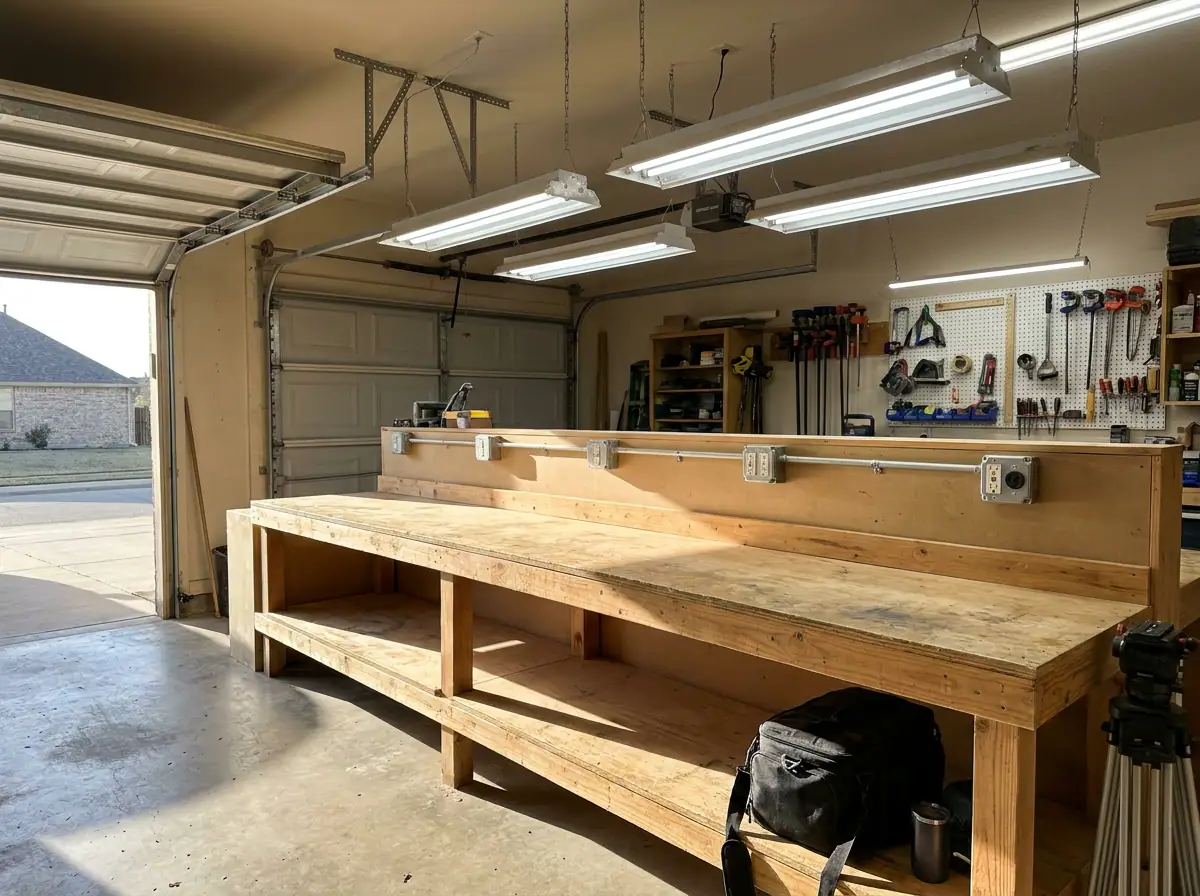
Most garages are wired to the bare minimum (a couple of general-purpose outlets, one light and the door opener), so before you add power tools, a freezer, a welder or an EV charger, you need dedicated circuits, GFCI-protected outlets in the right places, better lighting and a panel with room to spare. Start with safety (GFCI, AFCI and grounding), then add circuits, outlets and lighting, and plan panel capacity or a garage subpanel for future loads. A licensed electrician should do the work, pull the permits and can usually finish a typical garage upgrade in a day or two.
Why Most Garages Are Underpowered
Builders wire garages to satisfy the code minimum at the time of construction, not for how the space will be used. That usually means one or two 15-amp or 20-amp general-purpose circuits, basic overhead lighting and a circuit for the garage door opener. Older homes in Granbury and across Hood County are especially likely to have outdated or undersized garage wiring.
Today the garage is often a workshop, home gym, laundry area, storage room, hobby space or side-business base, running table saws, air compressors, welders, shop vacs, chest freezers, space heaters, battery chargers and mini-fridges from that same limited supply. Garages also face moisture, dust and temperature swings that raise electrical risk.
Warning signs your garage needs more capacity
- Breakers trip when you start a saw or compressor. Learn why repeated breaker trips should be fixed rather than just reset.
- Lights flicker when power tools start.
- Outlets feel warm, spark, are loose or stop working.
- Heat builds up in wiring, or cords look frayed.
- You are daisy-chaining extension cords across the floor. Code does not allow extension cords as permanent wiring, and they are a leading cause of garage electrical hazards.
Safety First: GFCI, AFCI and Grounding
- GFCI protection: the National Electrical Code (NEC) requires GFCI protection for all garage receptacles, and outdoor receptacles need it too. A Ground Fault Circuit Interrupter cuts power instantly when it detects current leaking along an unintended path, such as through a person. North Texas humidity swings and seasonal rain make damp garages more prone to faults, so if your garage outlets are not GFCI protected, that needs correcting.
- AFCI protection: Arc-Fault Circuit Interrupters detect dangerous arcing that can cause fires and are increasingly required by code for many branch circuits.
- Grounding and bonding: older homes may have two-prong outlets or poor grounding. Upgrading outlets and making sure the system is properly bonded protects sensitive electronics and keeps tool use safe. Signs of faulty wiring should be checked before anything new is added.
Dedicated Circuits for Tools and High-Draw Equipment
A dedicated circuit gives one tool or appliance its own breaker so it never shares amperage with anything else. It is the single most impactful garage upgrade: it stops nuisance trips and protects both your equipment and your wiring.
What typically needs its own circuit
- Table saws and miter saws: most contractor-grade saws draw 15 amps or more at startup and need at least a dedicated 20-amp circuit.
- Air compressors: they pull heavy current at startup and typically need a dedicated 20-amp or 30-amp circuit depending on motor size.
- Welders: depending on type, a 30, 40 or 50-amp dedicated circuit with the correct outlet configuration.
- Garage refrigerators and chest freezers: they cycle on and off all day and should not share a circuit with tools, or they may trip unexpectedly.
- Level 2 EV chargers: a dedicated 240-volt circuit, typically 40 to 50 amps.
- Mini-splits, portable AC units and space heaters: climate control often needs a dedicated circuit, frequently 240-volt.
- Garage door openers with battery backup: newer smart openers draw more than older models and often work best on their own circuit.
240-volt outlets may also be needed for electric dryers or powerful compressors, so plan them ahead to avoid costly rewiring later. Running new circuits from the panel requires a licensed electrician and knowledge of local code. See our circuit installation service.
Outlet Placement and Types
Where your outlets are matters as much as how many you have. Older garages often have a few outlets clustered on one wall, so cords end up stretched across the floor.
- Perimeter outlets: spaced along the walls so any point in the garage is within reach of a standard cord.
- Workbench outlets: at or above bench height so you are never more than a few feet from a plug and cords stay off the floor.
- Ceiling outlets: for retractable cord reels and overhead equipment such as dust collectors.
- 240-volt outlets: placed for welders, large compressors or EV chargers, with the correct NEMA configuration for your equipment.
- Weatherproof exterior outlets: near the garage door or outside wall for holiday lights, lawn equipment and pressure washers.
- Smart or USB outlets: where you charge phones, tablets and battery tools, keeping cords tidy.
Replace old or damaged outlets as part of the job. Our outlet installation and outlet repair services cover both.
Garage and Workshop Lighting
A single dim bulb is a safety hazard: poor visibility leads to mistakes, injuries and missed details. Lighting is often the first improvement homeowners notice.
- General lighting: high-output LED shop lights or flush-mount LED panels give bright, even light from the front of the bay to the back wall with no dark corners or harsh shadows. LEDs are energy-efficient and long-lasting.
- Task lighting: a bright strip over the workbench, a focused light over the drill press, or under-cabinet LEDs in a finishing area.
- Sensors: motion sensors near entry points and dusk-to-dawn sensors add convenience and save energy, especially on dark mornings and evenings.
- Exterior lighting: fixtures at the garage door, along the driveway and at side entries add security and curb appeal. They must be weather-rated and properly grounded.
- Emergency lighting or backup power: a circuit tied to backup power if you rely on garage equipment during outages.
Professional lighting installation places fixtures where they work best and wires them safely.
Panel Capacity and Garage Subpanels
Every added dedicated circuit, 240-volt outlet or EV charger needs free breaker slots and enough panel capacity. Many Granbury homes, particularly those more than 20 to 30 years old, have panels never designed for today's demand. If your panel is full, outdated or undersized, the upgrade may start with a panel change.
A garage subpanel is often the cleanest answer. Fed from the main panel, it gives the garage its own breaker box, making it easy to add circuits and manage loads without crowding the main panel.
Detached garages, workshops and outbuildings
Wiring a detached garage, workshop, barn, guest house or ADU is different from upgrading an attached garage. The building usually needs its own subpanel fed from the house by an underground feeder cable or overhead line. That means calculating the load, choosing the right wire gauge and conduit, and installing a properly sized subpanel. Underground wiring must be at the correct burial depth and protected from moisture. This is not DIY work. See our new construction service for additions and secondary structures.
Future-Proofing: EV Readiness and Resale Value
- Pre-run conduit or install a 240-volt pull point during other work so adding an EV charger later is simple.
- Ask whether a panel upgrade or subpanel will make future additions such as an EV charger, generator hookup, HVAC or major workshop tools easier.
- Keep receipts and inspection records. Permitted, code-compliant work builds buyer confidence and adds resale value.
- Build in a little extra capacity from the start: garages tend to be rolling projects.
Permits and Code Compliance in Hood County
Significant garage work (new circuits, new outlets, a subpanel or 240-volt wiring) typically requires a permit in Hood County. The permit and inspection make sure the work is safe and correct. Unpermitted electrical work can cause problems when you sell the home, file an insurance claim or if something goes wrong. A licensed electrician follows the NEC as adopted in Texas, and Revamped Electric handles the permitting and inspection as part of the job.
How to Plan and Prioritize Your Garage Project
- Do a quick safety scan: warm outlets, frayed cords or frequent trips mean you should schedule an inspection right away.
- List your needs: what tools and equipment you run now and plan to add, whether you want an EV charger or generator hookup, a workbench area, a lighting overhaul, smart outlets, and whether the garage is attached or detached.
- Check your panel: note the main panel rating and any spare breaker space.
- Get a professional assessment: a licensed electrician will create a plan, estimate costs and handle permits and inspections.
- Work in phases if needed: safety upgrades first (GFCI, AFCI, grounding), then functional upgrades (outlets, circuits, lighting), then future-proofing.
Most garage upgrades are straightforward and take a day or two depending on scope, with minimal disruption. The best time is before problems start, especially if you are adding an EV charger, building out a workshop or converting the garage into living or studio space as part of a remodel.
Frequently Asked Questions
Why does my breaker trip when I use power tools in the garage?
Most garages have one or two shared general-purpose circuits. High-draw tools like table saws and compressors overload them, especially at startup. Dedicated circuits fix the problem.
What circuit does a Level 2 EV charger need?
Its own dedicated 240-volt circuit, typically 40 to 50 amps. Your panel must have the capacity and space for it.
Do garage outlets need GFCI protection?
Yes. The NEC requires GFCI protection for all garage receptacles because garages are damp, dusty environments with a higher shock risk.
Should I add a subpanel to my garage?
If you plan several new circuits or serious workshop equipment, a subpanel fed from the main panel makes adding circuits and managing loads much easier. A detached garage or workshop usually needs one.
Do I need a permit for garage electrical work?
Adding circuits, outlets, a subpanel or 240-volt wiring typically requires a permit in Hood County. A licensed electrician pulls it and arranges the inspection.
How long does a garage electrical upgrade take?
Most take a day or two depending on scope. A panel upgrade or detached building feed can add time.
Revamped Electric is a veteran-owned electrician serving Granbury, Weatherford, Stephenville, Benbrook, Mineral Wells and the rest of Hood, Parker, Johnson and Somervell counties, with upfront pricing and no overselling. Whether you need one dedicated circuit or a full workshop wiring plan, call us at 817-677-0036 or request a quote. You can also see all of our electrical services.