

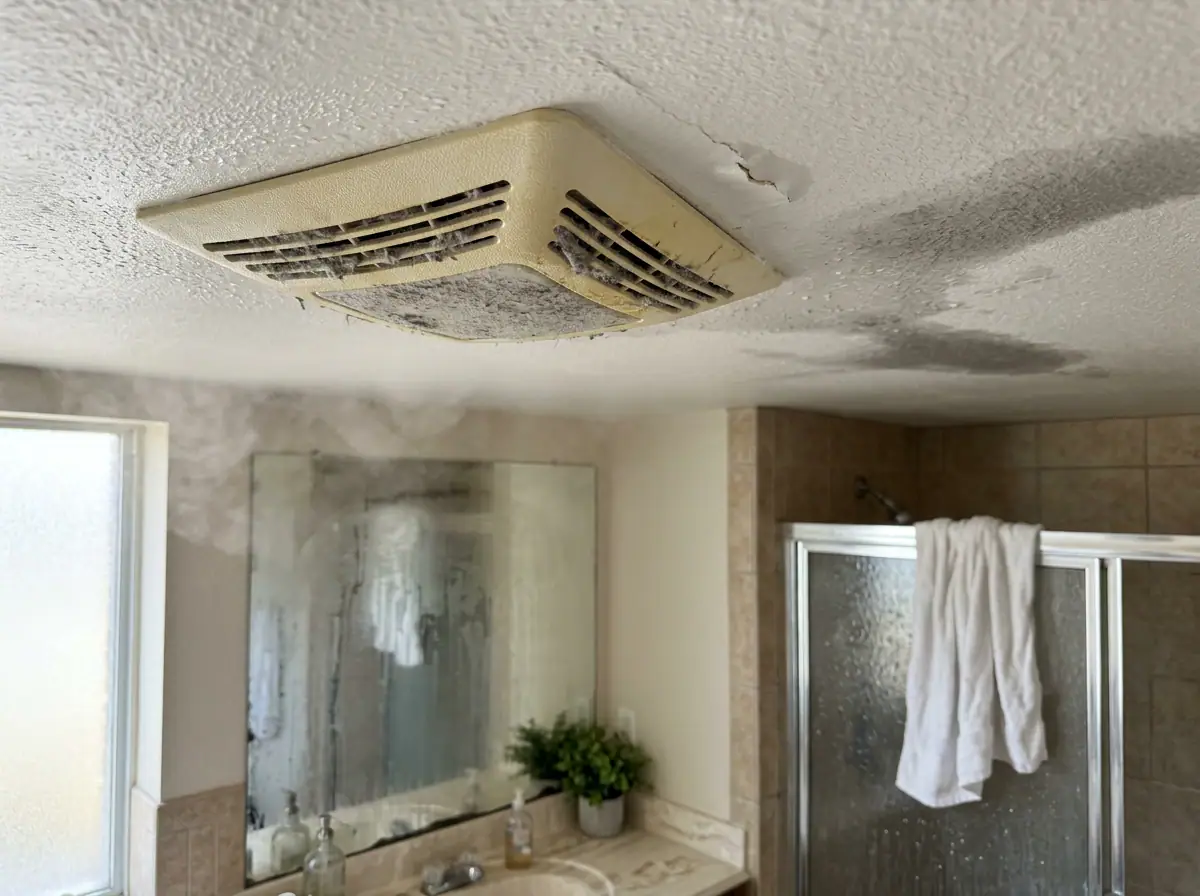
If your bathroom mirror stays fogged long after the shower is off, or the fan above you sounds like a coffee can full of marbles, you probably need bathroom exhaust fan repair or a new unit. In a humid Hood County home, a fan that does not move air is more than an annoyance. It lets moisture settle into drywall, paint, trim and attic framing.
We are Revamped Electric, a licensed, veteran-owned electrical contractor based in Granbury, TX. Owner Austin Barrett and co-owner Nick Torres wrote this page to help you work out in a few minutes whether your fan needs a simple fix, a replacement, or a wiring repair, and who to call when it is more than a weekend project.
Bathroom Exhaust Fan Repair: What the Symptoms Usually Mean
Most fan problems fall into a handful of patterns. Knowing which one you have makes the next step much easier.
The fan hums but does not spin
This usually points to a motor that is seized or struggling. Dust and lint can bind the blower wheel, and bearings dry out over time. Sometimes the fan has power but the motor cannot start. A good cleaning occasionally brings it back. If it still hums and will not turn, the motor is on its way out.
Loud rattling, grinding or a noisy bathroom exhaust fan
Rattling often means a loose housing, a loose grille, or a wheel that has shifted. Grinding or a rising whine usually means worn motor bearings. Older builder-grade fans are often loud even when they are healthy, so a noisy bathroom exhaust fan sometimes is not broken, just outdated.
The fan runs but does not clear steam
If the fan sounds fine but the mirror stays wet, the problem is airflow, not power. Common causes include a clogged grille, crushed or disconnected attic ductwork, a stuck exterior vent flap, or a fan that is simply too small for the room. This is the symptom most people misdiagnose as a bad motor.
The bathroom exhaust fan is not working at all
A fan that will not turn on could have a failed switch, a tripped breaker, a loose connection, a dead motor, or a wiring fault. This one deserves a few safe checks before you call anyone.
Safe Checks You Can Do Before You Call
You can rule out the easy stuff without opening anything up.
- Try the switch. If the fan shares a switch with the light, check that the light works. If the light works but the fan does not, the fan or its connection is the likely issue. If neither works, look at the switch or circuit.
- Check the breaker. Look at your panel for a tripped breaker and reset it once. If it trips again right away, stop. A breaker that keeps tripping is telling you something, and our page on tripping breakers explains why you should not keep resetting it.
- Reset the GFCI. In many bathrooms, the fan or light is on a circuit protected by a GFCI outlet that may be located in the same bathroom or a nearby one. Press reset on any GFCI you can find. Our guide to GFCI outlets in Granbury covers where they hide.
- Look at the grille. With the power off at the switch, a gentle vacuum of the cover can show whether lint is the culprit.
When to stop and call a licensed electrician: a burning smell, discolored or warm switch plates, buzzing or sparking, a breaker that will not stay reset, flickering lights along with the fan problem, or any need to open the fan housing or work in the attic wiring. Attics in North Texas get dangerously hot, and live wiring is not a place to experiment. If you notice signs of faulty wiring, let us look at it.
Repair or Replace: How to Decide
Here is how we think about it when we walk into a Granbury bathroom.
When a repair makes sense
- The fan is relatively newer and the housing and duct are in good shape.
- The problem is a bad wall switch, a loose connection, or a failed fan motor on a model where parts are available and the repair is sensible.
- Cleaning restores airflow and quiet operation.
When bathroom exhaust fan replacement is the better call
- The fan is old, loud, and moves very little air even when it runs.
- The motor has failed on a fan that is hard to service or no longer supported.
- The fan is undersized for the bathroom, which is common in remodeled or enlarged bathrooms.
- The housing is rusted, cracked, or the old unit has no proper duct connection.
- You want a humidity-sensing fan, a timer switch, or a quieter model anyway.
Our honest approach: if a repair is the smarter move, we will say so. If a replacement saves you from paying for the same fix twice, we will say that too.
Why Venting Matters in a Lake-Area Climate
Around Lake Granbury, summers are hot and humid, and moist air finds every cool surface. A bathroom fan is supposed to pull that moisture out of the house and push it outdoors through an exterior vent. When it does not, moisture can linger on walls and ceilings, and mold and mildew are far more likely to take hold.
One mistake we see in homes of all ages is attic ductwork that ends in the attic instead of at a roof or wall vent. That dumps warm, wet air into the insulation and framing, which is exactly where you do not want it. Manufacturer instructions and building codes call for a fan to discharge outdoors, with duct that is properly connected and routed. A crushed flex duct, a loose connection, or a stuck exterior vent flap can make a good fan perform like a bad one. During a replacement, we check the whole path, not just the fan box.
Bathroom Fan Installation Upgrades Worth Considering
If you are replacing the fan, this is the time to improve it.
- CFM rating: CFM measures how much air the fan moves. A common rule of thumb for smaller bathrooms is about one CFM per square foot of floor area, with bigger or more complex bathrooms needing more. Bathrooms with a large soaking tub or a steam-heavy shower often benefit from a stronger fan. Duct length and bends reduce real-world performance, so the number on the box is only part of the story.
- Humidity-sensing fan: It turns on when moisture rises and shuts off when the air is dry, which helps if family members forget to switch it on or off.
- Timer switch: A simple way to let the fan run after the shower without relying on memory.
- Quieter fans: Newer models are far quieter than older builder-grade units. If you avoid using the fan because of the noise, this upgrade changes that.
- Fan and light combos: A combined fan and light unit can tidy up a bathroom ceiling, though the wiring and switching need to be planned so each function works the way you want.
If you are already planning lighting or fixture changes, our article on electrical wiring for home remodels helps you think through the bigger picture.
Wiring, Switches and Circuit Considerations
Sometimes the fan is fine and the wiring is the problem. Here are the situations where we look beyond the fan itself.
- New wiring: Older homes may have a fan wired in a way that no longer fits a newer fan, or there may be no good path for a switch leg or cable in the ceiling.
- A different switch: A humidity-sensing fan or timer switch may need different switch wiring than the old one-gang toggle.
- Circuit changes: If the fan, lights, heater and outlets are all pulling from one overloaded circuit, we may recommend splitting loads. When the bathroom needs more capacity, a new circuit installation is the clean fix.
- GFCI protection: Bathroom receptacles require GFCI protection, and a fan or light installed over a tub or shower must be rated for that wet location. Depending on the fixture and manufacturer instructions, GFCI protection may apply to the fan circuit too. For the full rundown, read our guide to bathroom electrical safety and code requirements.
What Affects the Cost of Bathroom Exhaust Fan Repair or Replacement
We do not quote prices on a web page, because every bathroom is different. We would rather give you a real estimate after we see the job. These are the factors that move the number:
- Access: A fan with open attic access above it is a very different job from one under a finished second floor ceiling or a tight space.
- Ductwork and venting: Replacing damaged attic ductwork or adding a new roof or wall exterior vent takes more time and materials than swapping a fan on existing, sound duct.
- Fan type: A basic replacement costs less than a quiet, high-CFM, humidity-sensing or fan and light combination unit.
- Wiring updates: New cable, a different switch, a GFCI change or a circuit adjustment adds to the scope.
- Repair or replace: A simple switch or connection fix is usually the lowest-effort option, while a full replacement takes more.
Revamped Electric offers upfront estimates and free quotes, so you know what the work involves before we start.
Bathroom Fan Installation in Granbury and Surrounding Hood County Towns
Revamped Electric is a licensed electrical contractor in Texas, headquartered at 5630 Barkridge Dr in Granbury. Austin Barrett is a U.S. Navy veteran, and Nick Torres is a Granbury native with deep experience in new construction and service calls. Learn more about our team or browse our full list of electrical services.
We handle bathroom exhaust fan repair and installation in Granbury, Tolar, Cresson, Stephenville and Weatherford, along with nearby communities in Hood County and beyond. When you book, tell us what the fan is doing, how old it is, and whether there is attic access above the bathroom. Photos of the fan cover and the exterior vent help us show up prepared.
Bathroom Exhaust Fan FAQ
Can an electrician fix my bathroom fan?
Yes. A licensed electrician can diagnose switch, wiring and motor problems, replace the fan, and make sure the wiring and GFCI protection meet code. We also check the duct and exterior vent, since weak airflow is often a venting problem rather than an electrical one.
How long does a bathroom fan last?
It varies by quality, usage and how much dust and moisture it handles, but many fans last around a decade or more. Cheaper, older units tend to get louder and weaker with age. If your fan is noisy and not clearing steam, it is often at the end of its service life.
Why is my bathroom fan so loud?
Common causes are lint buildup on the blower wheel, a loose housing or grille, worn motor bearings, or a fan that was never very quiet to begin with. Cleaning and tightening can help, while worn bearings usually mean replacement. Newer fans are available in much quieter versions.
Does my bathroom fan have to vent outside?
Yes. A bathroom fan should discharge through a duct to an exterior vent, not into the attic. Venting into the attic puts warm, moist air into your insulation and framing, which can lead to moisture damage and mold.
If your bathroom fan is humming, rattling, not turning on, or leaving the mirror fogged, give Revamped Electric a call at 817-677-0036 or use our contact page to book a bathroom fan repair or replacement visit in Granbury and the surrounding Hood County towns. We will find out what is going on, tell you plainly whether it needs a fix, a new fan or a wiring repair, and give you an upfront estimate before any work begins.