

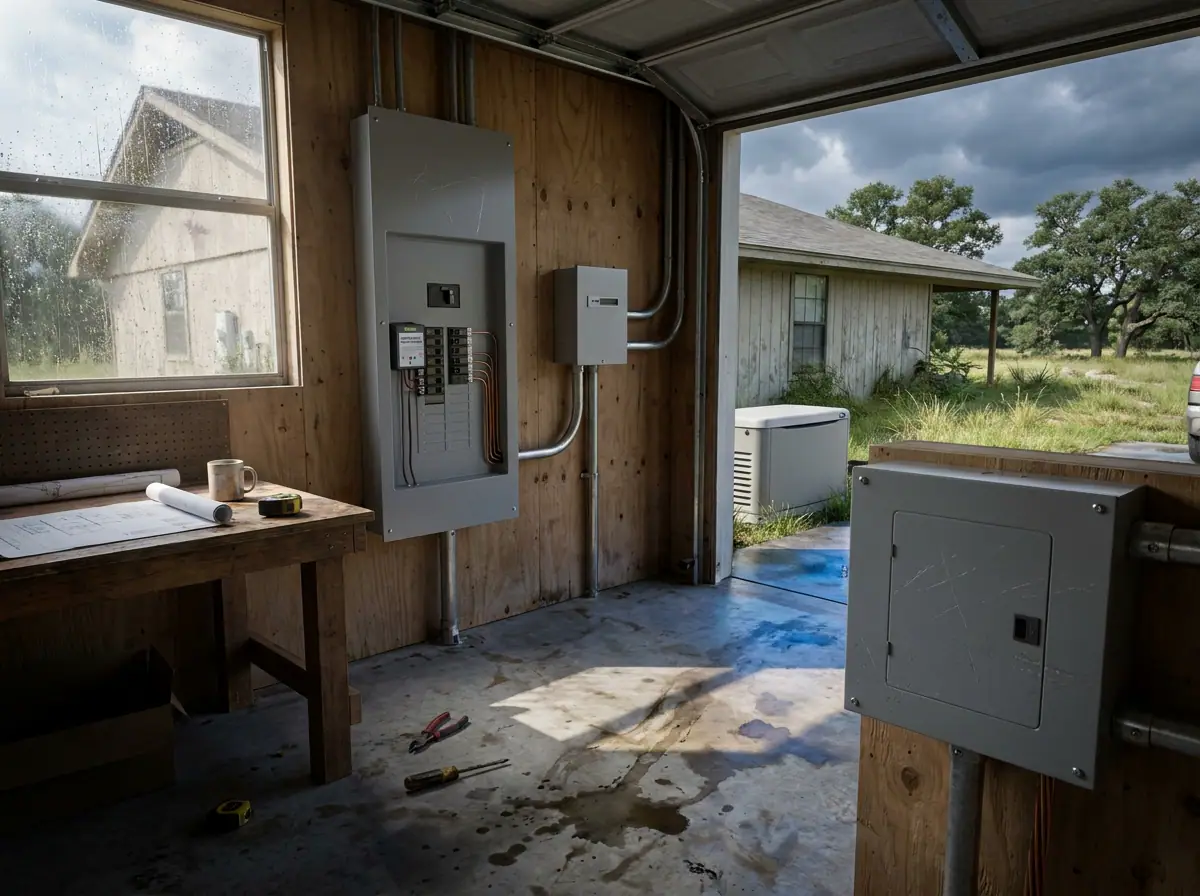
If you have lived in Granbury, Tolar, Weatherford, or anywhere across Hood and Parker counties for more than a season or two, you already know that Texas weather does not play by the rules. Severe thunderstorms roll through with little warning, summer heat waves push the grid to its limits, and when the power blinks or disappears entirely, you feel it fast. Food spoils, HVAC systems shut down, and every device plugged into your walls takes a hit from the voltage spike that follows.
What most homeowners do not realize is that the damage from power events happens in two ways: the obvious outage you can see, and the invisible surge damage you cannot. Both are preventable with the right electrical solutions in place. At Revamped Electric, we work with Granbury-area homeowners every week who are dealing with the aftermath of events that proper surge protection or backup power planning could have softened significantly.
This guide walks you through what whole-home surge protection actually does, how backup power systems connect to your home’s electrical panel, what options are available for homeowners in the Granbury area, and how to decide which solution fits your situation best.
Why Granbury Homeowners Face a Higher Risk for Power Surges and Outages
Texas sits in a unique position when it comes to electrical reliability. The state operates on its own power grid, meaning it has less flexibility to borrow capacity from neighboring states during peak demand or storm recovery. Add in the frequency of severe storms across Hood, Parker, Johnson, and Somervell counties, and local homeowners face a higher-than-average exposure to both extended outages and voltage irregularities.
Power surges do not only come from lightning strikes, though that is the most dramatic source. They also occur when:
- Large appliances like HVAC units, refrigerators, or well pumps cycle on and draw a burst of current
- Utility companies re-energize lines after an outage, sending a voltage spike through the system
- Neighbors on the same transformer run high-draw equipment
- Tree branches contact power lines during high winds
In rural and semi-rural areas around Granbury, Tolar, and Mineral Wells, homes are often at the end of long distribution lines, which makes voltage irregularities more common than in dense urban neighborhoods. That matters a great deal for expensive equipment like smart TVs, desktop computers, HVAC control boards, and modern kitchen appliances.
What Whole-Home Surge Protection Actually Does
You may already have a power strip with a built-in surge protector on your entertainment center or desk. That is a point-of-use protector, and while it provides a layer of defense for individual devices, it is not the same as whole-home surge protection installed at the electrical panel.
A whole-home surge protection device, also called a SPD or transient voltage surge suppressor, is wired directly into your main electrical panel. When a surge enters your home from the utility line, the device detects the excess voltage and redirects it safely to ground before it can reach your wiring, outlets, and connected devices. Think of it as a wide net catching the surge at the source, rather than individual filters at each outlet.
What It Protects
Modern homes have more voltage-sensitive equipment than ever before. Whole-home surge protection covers:
- HVAC systems and their control boards, which are often the most expensive item to replace after a surge
- Refrigerators and washing machines with electronic controls
- Smart home devices, security systems, and Wi-Fi routers
- Computers, televisions, and home theater equipment
- Well pumps and water heaters with electronic ignition
The installation process involves mounting the SPD at your electrical panel and connecting it to a dedicated breaker. For most homes, this is a straightforward job that takes a licensed electrician a short amount of time to complete correctly and to code.
Understanding Backup Power Options for Granbury Homes
Surge protection keeps your equipment safe during voltage spikes, but it does nothing to keep your lights on when the power goes out. That is where backup power comes in. Homeowners in the Granbury area have several realistic options depending on their budget, their property, and how much of their home they want to power during an outage.
Portable Generators
Portable generators are the most affordable entry point and are widely owned across Texas. However, they come with important limitations. A portable generator must never be connected directly to your home’s wiring without a proper transfer switch or interlock kit installed at the panel. Doing so creates a condition called backfeed, which sends electricity back into utility lines and can injure or kill utility workers restoring power in your neighborhood.
When a licensed electrician installs a transfer switch alongside your circuit installation, you can safely connect your portable generator to selected circuits in your home. This typically powers essentials like refrigerators, a few lights, fans, and phone charging stations.
Standby Generators
A whole-home standby generator is permanently installed outside your house, connected to your natural gas or propane supply, and wired into your electrical panel through an automatic transfer switch. When the utility power fails, the transfer switch detects the outage within seconds and starts the generator automatically. You barely notice the power went out.
Standby generators come in a range of sizes. A smaller unit in the 10-14 kW range can power the essentials in most Granbury homes. A larger 20-22 kW unit can power an entire home including central air conditioning. The right size depends on your panel capacity, your home’s square footage, and which loads you want covered.
The electrical work for a standby generator involves running a dedicated feed from the generator to an automatic transfer switch, coordinating with your gas provider for the fuel connection, and ensuring the installation meets local and state code requirements. This is not a DIY project, and it is not something to cut corners on.
Battery Backup Systems
Home battery storage systems like the Tesla Powerwall or similar products have become more popular as solar panel adoption has grown. These systems store electricity and deploy it automatically during an outage. They operate silently, require no fuel, and can be paired with solar panels for extended run times.
Battery systems do have capacity limits. A single large battery unit may carry a home through a brief overnight outage or power select critical loads for an extended period, but a multi-day outage during a heat wave may exceed its capacity without a solar recharge. Many homeowners pair a battery system with a smaller standby generator for layered backup coverage.
What Happens at the Electrical Panel During a Generator Installation
One of the most common questions homeowners ask is how a generator actually connects to their home. The short answer is that everything runs through the electrical panel, which is exactly why the panel’s condition matters before you invest in backup power.
An automatic transfer switch is either installed as a separate unit adjacent to the main panel, or in some systems, it is integrated directly into the panel itself. The transfer switch monitors the incoming utility voltage. When power drops, it disconnects your home from the utility grid and switches to the generator source. When utility power returns and stabilizes, it switches back and shuts down the generator.
This switching process is critical from a safety standpoint. It prevents the backfeed hazard mentioned earlier and protects your generator from damage when utility power returns. A properly installed transfer switch is not optional. It is a code requirement, and any reputable licensed electrician will insist on it.
If your home has an older panel, limited breaker space, or a panel that is already running near capacity, a backup power installation may involve a panel upgrade as a first step. This is worth knowing before you budget for the generator itself.
Surge Protection and Backup Power Together: A Layered Approach
The most resilient setup combines both solutions. Here is how they work together during a real-world power event:
- A storm causes a voltage spike on the utility line. Your whole-home surge protection device catches it at the panel and redirects it to ground. Your appliances and electronics are unaffected.
- The storm escalates and knocks out utility power entirely. Your automatic transfer switch detects the outage, starts the standby generator within seconds, and your home continues operating normally.
- When utility power returns, the transfer switch verifies the voltage is stable, switches your home back to grid power, and shuts down the generator. Another voltage spike during the switchover is caught by the surge protector.
This layered approach is particularly valuable for Granbury homeowners with home offices, medical equipment, livestock operations, or simply a household that cannot afford disruption during Texas storm season.
How to Get Started: What to Expect From a Professional Assessment
Before any equipment is purchased or installed, a licensed electrician should assess your current panel, your home’s electrical load, and your specific goals. During that visit, a qualified technician will look at your panel’s age and condition, identify whether you have available breaker space, calculate your home’s load to recommend the right generator size, and walk you through the options that fit your property and budget.
At Revamped Electric, we serve homeowners across Granbury, Weatherford, Aledo, Benbrook, Hudson Oaks, Stephenville, and the surrounding communities. We are a veteran-owned company, and we bring the same attention to detail and straight communication to every job that you would expect from someone who takes their work seriously. No inflated quotes, no vague timelines, and no guessing on code compliance.
If your home has never had a surge protection device installed, or if you have been thinking about backup power but did not know where to start, now is a good time to have that conversation before storm season is in full swing. Check out our full list of electrical services to see everything we handle, or reach out directly to schedule an assessment.
Power reliability in Granbury is not something you can count on the grid to solve for you. But it is absolutely something you can plan for with the right electrical setup in your home. Give us a call or fill out our contact form and we will get you on the schedule fast.